Cuil: The bizarre new search engine that seems to be straight from 1998

A "new" search engine called Cuil (pronounced "cool") just launched today.  The company was founded by some ex-Google employees. See press coverage here and here.


I put the word "new" in quotes because Cuil doesn't feel new at all. Sure, there are a couple interesting innovations. But with Cuil, I feel like it's 1998 all over again. Here's why:

  • Relevancy is horrible. Perhaps I should cut them some slack because it's only the search engine's first day. But still, I was amazed how poor the results were on the searches I performed. For example, I searched on the word manufacturing.  (Click screenshot above for a full view of my results). About half the results on the first page were laughable. An RC plane company? Ping golf? Perhaps the word "manufacturing" appears in their title tag or somewhere on these sites' home pages, but that's about it.  Compare Cuil's results to Google's or MSN's and you'll see the difference. It almost seemed as if Cuil crawled the web for pages that contained "manufacturing" and showed me a random sample of those pages. Wow.


  • Cuil is making a big deal about how they're crawling more pages than Google -- they claim about 3x more. But who cares? This seems like the type of boast that search engines used to make a decade ago, when biggest was the best. I thought we were finally past the size wars, search engine community?


    Who cares how big your index is? If I needed to read millions of pages on manufacturing today, perhaps Cuil would be better than Google. But when I'm doing a search, I usually only need one or two pages -- the one or two most relevant pages. Comparing search engines based solely on size is like comparing electric motors based solely on their wattage, or comparing cereals by how many different vitamins and minerals they have. Having a super low number in any of these situations is probably a bad thing -- but bigger doesn't necessarily equate to better.


  • They seem to have thrown out the concept of PageRank, one of the greatest innovations in search engine relevancy. That sounds like a giant jump backwards -- almost like Sony launching a brand new line of transistor radios. On Cuil's info page, they say, "Rather than rely on superficial popularity metrics, Cuil searches for and ranks pages based on their content and relevance. When we find a page with your keywords, we stay on that page and analyze the rest of its content, its concepts, their inter-relationships and the page’s coherency."


    Huh?


    I think they just said they're ignoring a tremendous body of knowledge. They're ignoring who links to who. Am I reading that correctly? Why would they do that? And how can you possibly build a more relevant search engine by ignoring linking data that makes up the fabric of the World Wide Web?


  • Where are the ads? I assume Cuil is just launching the search engine itself now, and they'll be developing the ad model later. (Yes, that's how Google started...) But it's a decade after Google, and the search industry has grown up. It seems odd that you'd launch a new search engine without having your monetization strategy already built in, like GoTo did in 1998.

All that being said, I like some things about Cuil. I like the interface. The tiled search results are an interesting approach, especially with the graphics presented alongside the results. The "Explore by Category" box could be an interesting innovation. I could see an existing player adopting some of the architecture here.


At best -- and assuming Cuil improves its relevancy -- I could see it hanging around for a year or two as a search alternative with 0.5% market share and a grassroots following. Then perhaps one of the big or medium-sized players would buy Cuil (even though in the MSNBC article linked above, Cuil's Anna Patterson claims it's not for sale).


When I saw the headlines about a new player in the search market, I was initially excited to see what the next Google-killer had up its sleeve.  But Cuil doesn't even deserve to be mentioned in the same sentence as Google or any of the other big players.

When targeted web ads aren't as good as untargeted ones

Jeff Jarvis made an interesting post to BuzzMachine this morning that got me thinking.

There's an underwear ad currently in the upper right of his blog. A reader made a comment about it not being relevant. (See screenshot of the ad, and reader's comment here) Jeff's witty response was, "Isn’t underwear relevant to us all?"

The man has a point. I'm sure most people reading his blog use this product known as "underwear" on a regular basis. But I also understand what the reader is getting at -- why an underwear ad on a business blog?

This is a perfect example of an untargeted web ad. The company selling the underwear isn't serving the ad based on searches for underwear, nor do they seem to be targeting a certain demographic or psychographic profile with this ad. If they wanted to target, they'd be buying Google AdWords or Facebook ads where they could choose the age, gender, education, location, and a bunch of other factors. This is something Facebook does particularly well -- see Matt Dickman's post and brief video tutorial on Facebook ad targeting.

For selling many products and services, targeting is great. In the case of Facebook targeted ads, you can reach only the buyers who match your pre-defined profile of a potential customer. This type of advertising eliminates waste, and it can make your ads more relevant to the potential customer. With Google AdWords displayed within search results, you're reaching customers who are actively looking for something. Google does a wonderful job of bringing together buyers and sellers, and that's what's turned the company into the powerhouse it is today.

Targeting too finely can sometimes hurt your marketing. What if you're wrong about who your potential customers are -- or should be? What if you think 18-24 year olds are your prime audience, but it turns out that 25-34 year olds end up loving your product while the younger crowd doesn't like it? If you're targeting ads solely to the 18-24 set and the 25-34 audience never sees it, your campaign will flop.

What if your product has mass appeal? Is targeting necessary? Hmm...

But getting back to the underwear ad on Jeff's blog. Is the ad really selling underwear? I say no. If it was selling underwear, a click-through would take you to a product category page that lets you choose underwear, or maybe even to this specific pair. But it doesn't. A click-through takes you to AmericanApparel.net -- that's right, their home page. Gasp!

I can't tell you how many times I've coached advertisers not to link their ad to their home page. It's accepted wisdom in the online ad industry nowadays. But in this case it works, because the advertiser isn't selling underwear. They're selling their brand, their style, their image.

They're also looking for buzz. Look, it's already generated several blog posts, a bunch of thought by readers, and no doubt plenty of click-throughs. Hmm...that's exactly what they were trying to accomplish. Their ad gets "extra legs" because there's a small controversy surrounding it.

The only question mark in my mind about this ad is its appropriateness in the workplace. I noticed the ad yesterday on Jeff's blog. I remember seeing it, being surprised that it was appearing on a business blog, and intentionally scrolling farther down the page so nobody saw it on my screen. So in that sense, it might be a little too edgy.

Overall I like the advertiser's untargeted approach here. Sure, a targeted ad on Facebook could have helped them reach the right demographics. A Google AdWords search ad could have put them in front of people searching for clothing. And they might be doing one or both of those things.  But there's a lot to say for buzz and branding to a wider audience -- and this ad accomplishes those goals well.

Microsoft's big errors unsubscribing users from emails: Are you making it easy for people on YOUR list to opt out?

In general, I think companies have gotten a lot better at managing their email unsubscribes in the past couple years. But there's always room to do better -- and there are still plenty of emailers who aren't doing a good job.

I was just reminded of this fact in the past week. I got an email from Microsoft that had an amazingly complex unsubscribe process. (I'm saying this not to pick on Microsoft -- because I realize it's a huge company with so many different email campaigns taking place, and probably tens of millions of people on its lists.) But I think there's plenty we can learn from Microsoft's poor process. Are you doing any of these things with your campaigns?

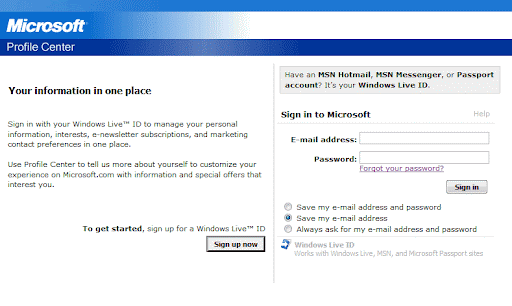
So to begin, I clicked on the unsubscribe link at the bottom of the message. Instead of taking me to a page where I could unsubscribe quickly, I get a login page for Microsoft Passport (see screenshot #1).

Best practice: Don't force your users to log in for an
unsubscribe request. When they click the link in the email, take them straight to the unsubscribe page.


They're expecting me to guess which email address I signed up for this newsletter with (I have several!), and they didn't bother to mention which one it was in the footer of their email.

Best practice: Always put a "You are subscribed as user@email.com" in the footer of your message to make it easier for your reader.

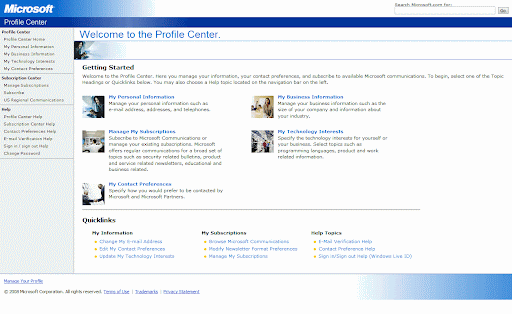
After finally figuring out which email address and which password they were expecting me to put in, I got to a page with a ton of information (see screenshot #2). Where do I click to unsubscribe? Do I choose "My Personal Information" where it says my email address is kept? No, here's a "Manage My Subscriptions" link below that, where it says I can change my subscriptions. That must be it. But wait...right below that it says "My Contact Preferences" where I can change how Microsoft contacts me. This email was from Microsoft. Oh, so confused! And then they add another list of nine quick links at the bottom, which only adds to the confusion.

Best practice: Once you get the user to the unsubscribe page, make it obvious where they're supposed to go to complete the process. They're not clicking the Unsubscribe link because they want to learn more about your company or because they want to change their technology interests. When they click Unsubscribe, they want to unsubscribe.

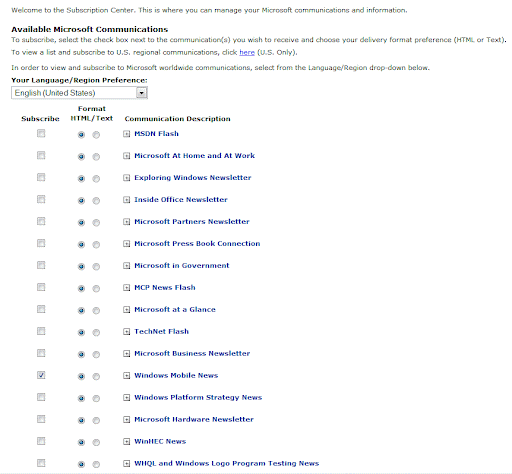
Once I figured out the right choice, it took me to a huge list of at least 30 newsletters and mailing lists, maybe more (view screenshot #3). The list was so long that I had to scroll to see the full thing. I wasn't signed up for most of these newsletters or lists, so I had to search through the list to find the single checkbox that was checked.

Best practice: Show the user what they're subscribed to, quickly and easily. Don't make them guess. Don't make them hunt.

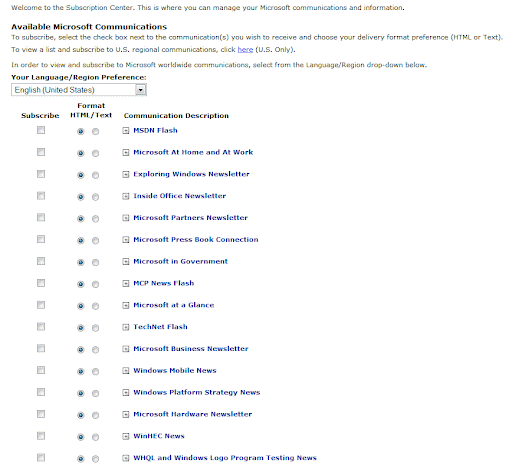
I'm almost there, right? I found the single checkbox that I need to uncheck. Now I'll uncheck it, scroll down to the bottom of the list, and hit the Update button. That should do it, right? Ummm...at least with Microsoft's interface, I'm not sure. If you take a look at screenshot #4, you'll notice it looks remarkably similar to #3. There's no confirmation anywhere saying "Your preferences have been updated" or anything like that.

Best practice: Once the user takes an action on your unsubscribe or newsletter preferences page, make it obvious they've taken an action. Ideally this would be a whole new screen saying "Your preferences have been updated" that would also give them a list of the changes that have taken place, e.g. "You have been unsubscribed from Windows Mobile News." If you can't do that for whatever reason, it's ok to take them back to the same page they just submitted, as long as there's a big, noticeable message that says "Preferences updated" or "You have been unsubscribed." It should be at least 1 1/2 times the size of the next largest font on that page, and it should be in a bright color or some other treatment that makes it impossible to miss.

Best practice: Email confirmation. Send your user an email confirming they've changed their preference or unsubscribed. That way they're sure the action has been processed. (I know some people aren't a fan of the email confirmation for unsubscribes...thinking that it's stupid to send someone an email immediately after they say they don't want any more email from you. Personally when I unsubscribe, I don't mind these messages, and I think it's perfectly acceptable. I'd recommend following one of my favorite rules for communication: Tell them what you're going to do, do it, then tell them what you just did.)

There are certainly many more email unsubscription best practices, and these are just a few. When thinking about your unsubscribe processes, here's what I recommend:

1) Read CAN-SPAM closely (including the most recent rulings from May 2008) and make sure you're complying to the letter of the law.

2) Read CAN-SPAM a second time and make sure you're not just complying with the letter of the law, but also the spirit of the law.

3) Go a step beyond the spirit of the law. Make your unsubscribe process so quick and painless that it's almost pleasant. Legitimate companies comply with the law. Good companies uphold the spirit of the law. And the best companies give the customer an experience so good that they make the customer say WOW!

Google now indexing Flash files, revealing otherwise hidden pages

Back in April I mentioned that Google was beginning to index the "invisible web" by going through forms on websites. Now according to a post in the Google Webmaster Central Blog, Google will begin indexing parts of Adobe Flash files as well, including URLs that appear in Flash files.

This change probably won't have a big effect on websites that have the now-ubiquitous Flash element on the home page. (The current iteration of Intel's and PTC's websites come to mind, but you can see Flash on the home pages of thousands of companies nowadays. It's almost as widespread as the Flash "splash screen" that was in style among web designers for a number of years, until savvy webmasters realized they generally hurt search engine results.) Most of these home page Flash elements aren't purposely trying to hide URLs or information within the file, so you shouldn't have any problem if Google decides to index it and display the results in searches.

The sites that will have problems are the ones using Flash applications for more than just eye candy on their site -- for example, an application that gathers information, then passes the user to a "hidden" URL. If your Flash isn't coded properly, Google could find the URLs and let people into areas you don't want them to get into...at least not without completing some other action. See this post and the associated comments for a good discussion on techniques.

Just like I mentioned in my post in April, a thorough robots.txt file should save you a lot of headaches if you're putting "secret" URLs into Flash.

If you're using Flash, talk to your web developer to make sure this new change isn't going to expose too many of your pages to Google.

Happy 10th birthday, pay-per-click (PPC) advertising -- part 2 of 2

...Continued from yesterday (click here for yesterday's post)


It's Independence Day, the birthday of our country. But in addition to celebrating America's special day, I'm celebrating the 10th birthday of PPC advertising.


GoTo was making constant improvements to its interface and its bidding system. The company had pioneered the "search term suggestion tool" in its early days, to give advertisers an idea of which terms might be relevant to their campaigns. The GoTo tools could also give approximate counts on the number of searches being performed on any given term, which was extremely helpful for determining howmuch traffic you'd get.


Another GoTo innovation involved full disclosure. From the very beginning of GoTo's pay-per-click days, the company made advertisers' bids transparent -- not only to other advertisers, but also to search engine end users. When you did a search on GoTo, you could instantly tell how much an advertiser was bidding per click  because a note like "Cost to advertiser: $0.05" appeared next to each listing.


Despite the dot-com bust in 2000-2001, GoTo kept growing. In October 2001, the company changed its name to Overture. Through established partnerships with Yahoo! and MSN, it was distributing its paid search results to a huge number of Internet users. At one point I remember seeing Overture marketing materials that claimed the percentage reach of their PPC ads. Although I don't remember exact numbers, I recall they were quite impressive.


Although Google -- the current market leader -- launched its AdWords platform in 2000, it was started as a CPM (cost per thousand impressions) product. It wasn't until 2002 that AdWords received a major update, switching to the CPC model it uses today. Google's deal to distribute its ads through AOL was also a major milestone in 2002.  My first experience with AdWords came in 2002, shortly after the company switched to the CPC model. I remember being amazed that it had taken Google two years to make the move from CPM to CPC! This was the beginning of Google AdWords' dominance in the sponsored search market.


Overture was acquired by Yahoo! in 2003. Shortly thereafter, the Overture name was dropped in favor of Yahoo! Search Marketing.


In 2004, Google and Yahoo settled a patent lawsuit. GoTo (later Overture, then Yahoo!) owned a patent related to pay-per-click bidding. Overture sued Google for patent infringement in 2002, and the suit was finally settled out of court in 2004 after Yahoo!'s acquisition of Overture, with Google issuing 2.7 million shares of stock to Yahoo!.


Microsoft, the last of the "big three" to the PPC advertising game, launched MSN adCenter in 2006. I participated in the beta in late 2005 prior to launch, and I wasn't impressed at all. It was quite buggy during beta, with ads not displaying for me and a number of other advertisers. Since then, adCenter has seen a lot of improvements, but it still has only about a 5% market share, compared to Yahoo!'s 15% and Google's 79%.


According to eMarketer, paid search will continue to dominate online advertising for at least the next few years, near a 40% share of all online ad spending. The market is maturing, but it's still the cash cow of the Internet advertising world. The revenue from pay-per-click has fueled Google's growth, and I suspect it will continue to do so.


Happy 10th birthday, sponsored search! It's been a crazy and fun ride. But I have a feeling the ride is just getting started.

Happy 10th birthday, pay-per-click (PPC) advertising -- part 1 of 2

As we prepare for our country's 232nd birthday tomorrow, I think it's only appropriate to honor the fusion of American capitalism and the search engine.


Whether you call it pay-per-click advertising or PPC (or now that it's all grown up, does it prefer to go by the name "paid search" or "sponsored search"?), this field has grown into one of the most acclaimed, most discussed, and most closely watched barometers of Internet advertising. However, PPC advertising had humble roots, and I was fortunate enough to watch and participate in the industry from the beginning. Here's a brief look back at my experiences and observations:


Although the modern era of pay-per-click ads took place in 1998 with the launch of GoTo.com, the model was piloted by Open Text back in 1996 through its "preferred placement" listings. Open Text abandoned PPC within a matter of a few weeks though, since there was a huge user uproar. The purist Web community wasn't ready for commercialized search engine results yet.


GoTo launched in 1998 to little fanfare. Many industry gurus didn't think it would be successful, given the failure of Open Text's experiment. For example, search pioneer Danny Sullivan wrote in the March 3, 1998 issue of the Search Engine Watch e-newsletter:

"So there are many reasons why pay-for-placement makes sense. There's also a big reason against it. It just doesn’t feel right."


and


"What impact will GoTo have on the other search engines? Probably little. A quick call to representatives at Excite and Lycos found minimal interest. 'It will be interesting to see how this plays out. My feeling that the consumer wants something more cleaner than commercialism,' said Brett Bullington, Executive Vice President of Strategic and Business Development at Excite."

But for some reason, I had a feeling this paid search thing was going to be big. I remember reading the first announcement about the GoTo launch in Search Engine Watch and thinking, "Wow, this is a really great business model. I need to try this!" Maybe it was just my youthful exuberance or naïvety.


At the time I was working as the webmaster (and Internet marketing manager, and software specialist, and hardware guy) for a small automotive accessories manufacturer. I had just finished building their e-commerce site six months earlier, and I was struggling to help them grow traffic and sales. The GoTo pay-per-click model seemed like a perfect fit for the company, since it didn't require a huge capital outlay. I knew I wouldn't be able to justify a big spend with the president of the company -- after all, our $2-$3K classified ads in the back of Car and Driver and Motor Trend magazines were a huge investment for this small company that was just getting its feet wet in retail. So I knew I needed to prove a quick ROI on any programs I recommended. GoTo's PPC approach seemed to fit the bill perfectly, since it was a defined spend that could be scaled up and down based on our needs and the success of the program. Plus it would be easy to quantify. So we started small, with a plan to ramp up if it worked well.


Many people don't know this about the early days of pay-per-click, but originally there was no automated bid management system at GoTo. When the site launched, you had to send an email to GoTo with a list of the words you wanted to bid on, along with how much you were willing to spend per click. GoTo's account services team would make sure your ads met their editorial guidelines, and they'd post them within a day or two (my recollection is a little fuzzy on how long it took...but the one thing I remember was that it wasn't instant like today's PPC!). The same process would apply for changing bids -- you'd send your changes in an Excel spreadsheet via email, and they'd implement them manually.


When I placed our first bids on GoTo.com, there was nobody bidding for "auto accessories" and I think only a few companies were even bidding on "cars"! It stayed that way for a couple months. (If there were no bids or only a few bids on a search term, GoTo would display results from another search engine...Inktomi maybe?...below the paid listings to "backfill" the results.)


As GoTo started to gain traction, the company launched a bid management system -- the precursor to today's automated Google AdWords or Yahoo! Search Marketing web interfaces. GoTo's tool was rudimentary compared to today's standards, but it finally put the bidding power in the hands of the marketers. No more sending Excel spreadsheets via email to the GoTo customer service team. That's when GoTo and the PPC business model started to take flight. (Here's a Search Engine Watch article from July 1, 1998, around this time.)


About a year after GoTo's launch, the company filed for an IPO. These were the dot-com boom days, and it seemed like there were a half dozen Internet companies going public each day. I was among the lucky ones to participate in GoTo's IPO. The company did an interesting thing -- it set aside a pre-defined number of shares for each of its customers. Customers could buy up to 100 shares at $15 apiece, and of course I jumped in on the action (I would've been crazy not to!). The stock opened at $27. Within a matter of months, it rose to $70+ per share. Also, I was one of a few customers quoted in GoTo's annual report that year. I don't remember what I said that was so deserving of inclusion, but I'm sure it was brilliant. :-)


Remember, all this was happening in the days before Google. Google didn't launch pay-per-click on the current market-leading AdWords platform until years later, in 2002!


To be continued tomorrow... (click here to view next post)